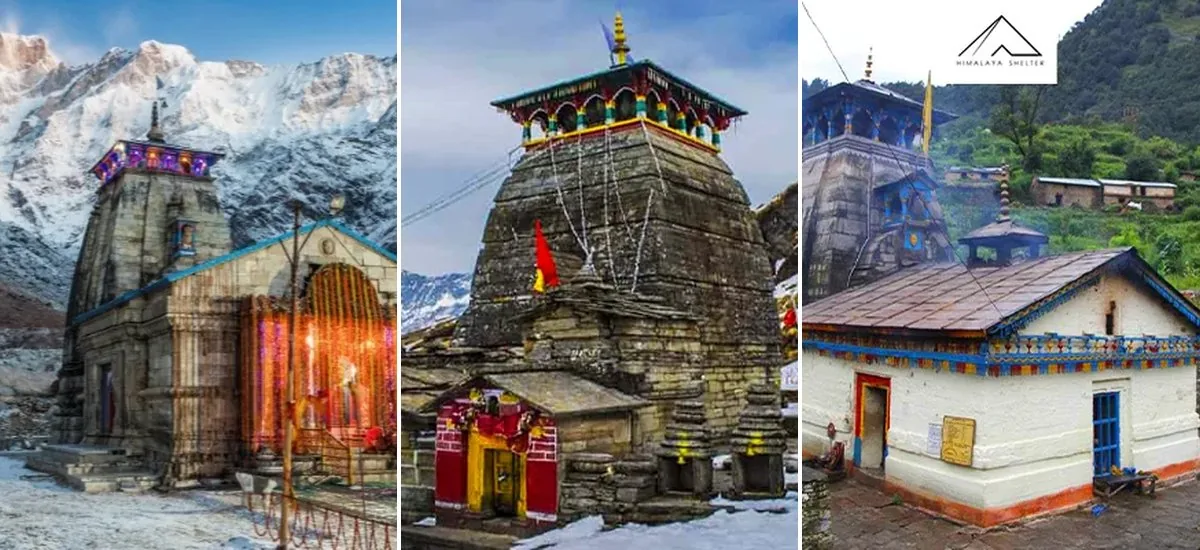
Panch Kedar Names Order Height and Map of the Five Shiva Temples
Quick answer: Panch Kedar is a group of five Shiva temples in the Garhwal Himalaya of Uttarakhand. In the traditional order, they are Kedarnath (3,583 m), Madhyamaheshwar (3,497 m), Tungnath (3,680 m), Rudranath (about 3,600 m) and Kalpeshwar (2,200 m). Tungnath is the highest, Rudranath is the toughest to reach, and Kalpeshwar is the only one open all year. To visit all five on foot, our Panch Kedar trek covers them in 13 days from Dehradun.
The name means "five Kedars". Each temple marks the place where a part of Lord Shiva is believed to have appeared, and together they make one of the oldest pilgrimage circuits in the Himalaya. This guide gives you the names (in English and Hindi), the order, the height of each temple, a simple route map, the usual opening and closing months, and how hard each walk is. It ends with the options for doing the Panch Kedar yatra as one trek or as separate shorter trips.
By Manish Barakoti, Himalaya Shelter. Heights, distances and trek details are from our own trek pages, checked on 20 October 2026. Temple dates are announced every year, so check them before you travel. Last updated: 20 October 2026.
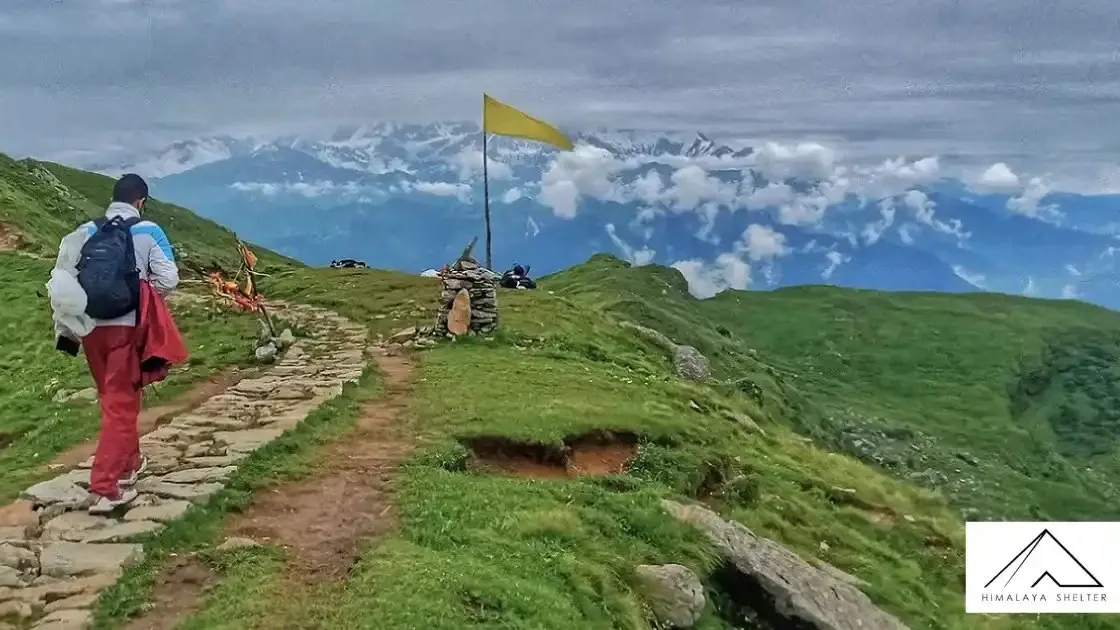
A trekker on the Panch Kedar trail in Garhwal.
What Is Panch Kedar?
Panch Kedar is the name for five temples of Lord Shiva spread across the Rudraprayag and Chamoli districts of Uttarakhand. Each one sits in a different valley, at a different height, and needs a different walk to reach it. Kedarnath is by far the best known, as it is also one of the twelve Jyotirlingas and one of the Char Dham. The other four are quieter and see far fewer pilgrims.
The story behind the circuit comes from the Mahabharata (general knowledge). After the war, the Pandavas wanted Lord Shiva's forgiveness for killing their own relatives. Shiva did not want to meet them and took the form of a bull. Bhima recognised the bull near Guptkashi, but before the Pandavas could reach it, it disappeared into the ground. Parts of its body then appeared at five places in the valley: the hump at Kedarnath, the navel and middle body at Madhyamaheshwar, the arms at Tungnath, the face at Rudranath and the matted hair at Kalpeshwar. The Pandavas built a temple at each spot, and these five became the Panch Kedar.
Panch Kedar Names
The five Panch Kedar names, in the traditional order, with the part of Shiva worshipped at each temple, are:
Temple
Part of Shiva
1. Kedarnath
Hump
2. Madhyamaheshwar
Navel and middle body
3. Tungnath
Arms (bahu)
4. Rudranath
Face (mukha)
5. Kalpeshwar
Matted hair (jata)
Panch Kedar ke naam (Hindi): पंच केदार के नाम हैं केदारनाथ, मध्यमहेश्वर, तुंगनाथ, रुद्रनाथ और कल्पेश्वर।
You will also see other names for the same temples. Madhyamaheshwar is often written Madmaheshwar or Madhmaheshwar. Kalpeshwar is also called Kalpnath and Jateshwar Mahadev, after the matted hair. At Rudranath, Shiva is worshipped as Neelkanth Mahadev, and Tungnath is widely known as Tungnath Mahadev.
Panch Kedar Order: Which Temple Comes First?
The traditional order of the Panch Kedar follows the legend, starting with the hump and ending with the hair. Locally the temples are often called by their number: Pratham (first) Kedar, Dwitiya (second) Kedar and so on.
Kedarnath (Pratham Kedar)
Madhyamaheshwar (Dwitiya Kedar)
Tungnath (Tritiya Kedar)
Rudranath (Chaturth Kedar)
Kalpeshwar (Pancham Kedar)
You do not have to visit them in this order. Many pilgrims follow it because it is customary, but the road network allows either direction. Our 13-day trek runs the circuit the other way round: Kalpeshwar first, then Rudranath, Tungnath, Madhyamaheshwar and finally Kedarnath. This direction starts with the shortest walk (Kalpeshwar) on day 2, links Kalpeshwar and Rudranath by an old trail over the ridge, and ends at Kedarnath, from where the road leads back to Rudraprayag and Dehradun.
Panch Kedar Height: Altitude of Each Temple
All five temples stand below 4,000 m, but four of them are above 3,400 m, high enough for altitude to matter. Here is the height of each temple in the traditional order.
Temple
Height
Kedarnath
3,583 m 11,755 ft
Madhyamaheshwar
3,497 m 11,473 ft
Tungnath
3,680 m 12,073 ft
Rudranath
about 3,600 m about 11,800 ft
Kalpeshwar
2,200 m 7,217 ft
Highest: Tungnath, at 3,680 m, is the highest Shiva temple in the world. Lowest: Kalpeshwar, at 2,200 m, in the Urgam Valley. You will find slightly different figures on other websites, especially for Rudranath and Madhyamaheshwar. The numbers above are the ones on our trek pages, and they are the ones our trek leaders use.
The Five Panch Kedar Temples in Detail
1. Kedarnath: the hump
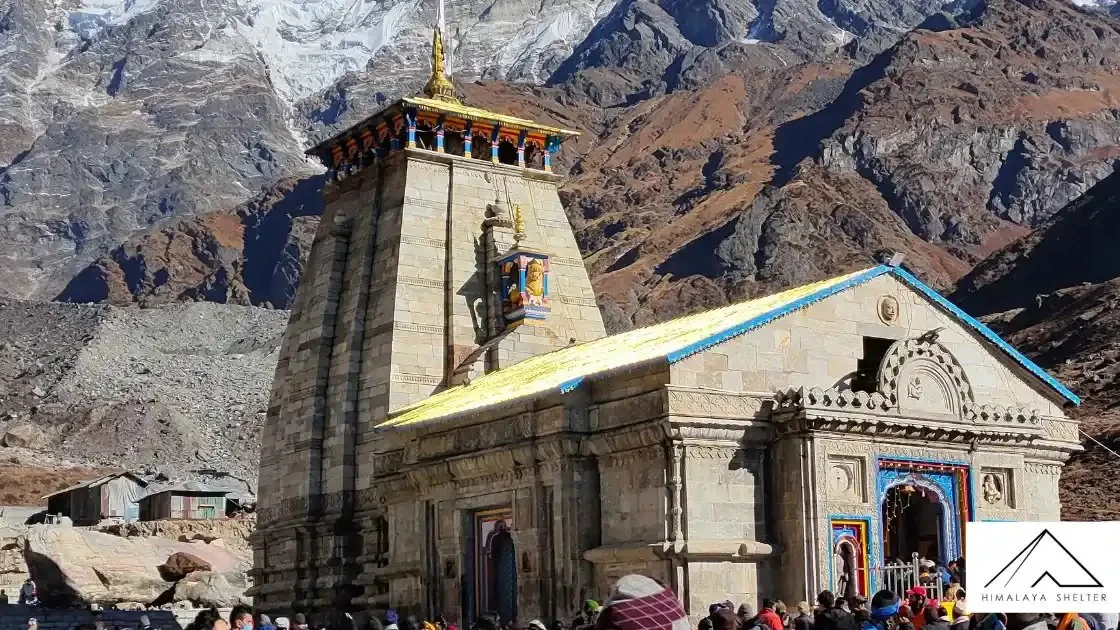
Kedarnath stands at 3,583 m (11,755 ft) on the bank of the Mandakini river in Rudraprayag district, right below the Kedarnath peak. Inside the temple, a cone-shaped rock is worshipped as the hump of the bull. It is one of the twelve Jyotirlingas and one of the Char Dham, so it is the busiest of the five by far.
The road ends at Gaurikund, about 250 km from Dehradun. From there, a 16 km trail climbs to the temple. The path is well made, with gravel and cement steps, but it is long and you share it with pilgrims and ponies. The temple usually opens on Akshaya Tritiya in April or May and closes around Diwali. In winter, the deity is worshipped at the Omkareshwar Temple in Ukhimath. Kedarnath also needs registration before you go. Read our Kedarnath Dham guide for more on the temple and the route.
Kedarnath, the first of the Panch Kedar, below the Kedarnath peak.
2. Madhyamaheshwar: the navel
Madhyamaheshwar stands at 3,497 m (11,473 ft) in Rudraprayag district. The main lingam is navel-shaped, as this is where the middle of the bull's body is believed to have appeared. The temple sits on an open meadow with a close view of the Chaukhamba peaks, and a short climb above it leads to the small shrine of Budha Madhyamaheshwar, one of the best viewpoints on the whole circuit.
The trek starts at Ransi village, about 242 km (8 to 9 hours) by road from Dehradun. The trail is 16 km each way through villages, forest and meadows, and it takes 5 to 6 hours to walk up. In winter the deity moves to Ukhimath. Our Buda Madmaheshwar trek covers this temple and the viewpoint in 4 days from Dehradun, about 32 km on foot, graded moderate.
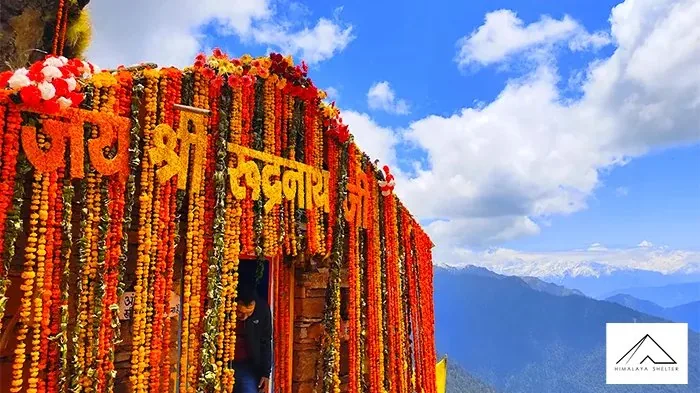
Madhyamaheshwar temple decorated with flowers.
3. Tungnath: the arms
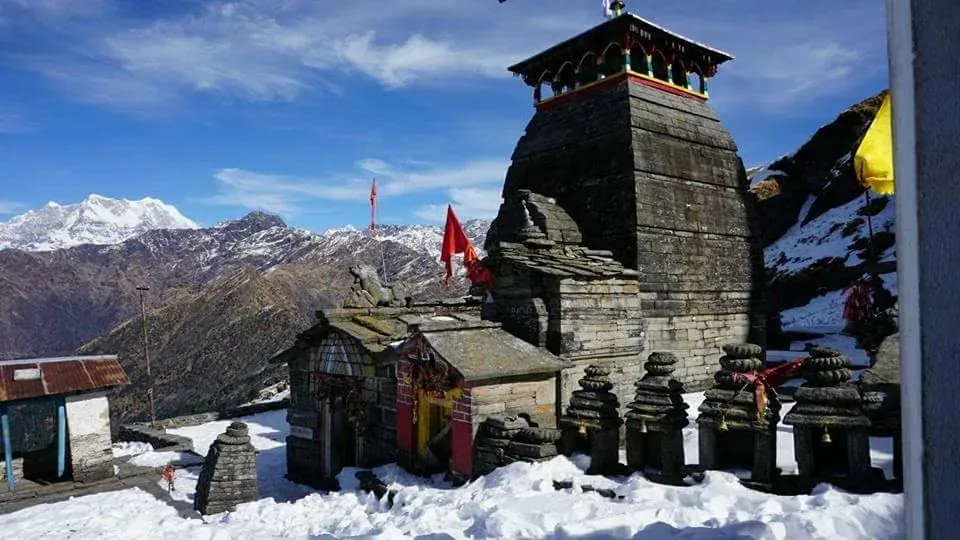
Tungnath, at 3,680 m (12,073 ft), is the highest Shiva temple in the world and the highest of the Panch Kedar. It is in Rudraprayag district, and the arms (bahu) of Shiva are worshipped here. The black stone temple is believed to be more than 1,000 years old.
It is also the easiest of the high temples to reach. The walk starts at Chopta and is 3.5 km on a paved path that climbs steadily through forest and meadows. Another 1.5 km beyond the temple takes you to Chandrashila summit, which has a wide view of Nanda Devi, Trishul and Chaukhamba. In winter the deity moves to Makkumath. Read our Tungnath temple guide, or join our 3-day Chopta Chandrashila Tungnath trek, graded easy.
Tungnath, the highest Shiva temple in the world, with snow around it.
4. Rudranath: the face
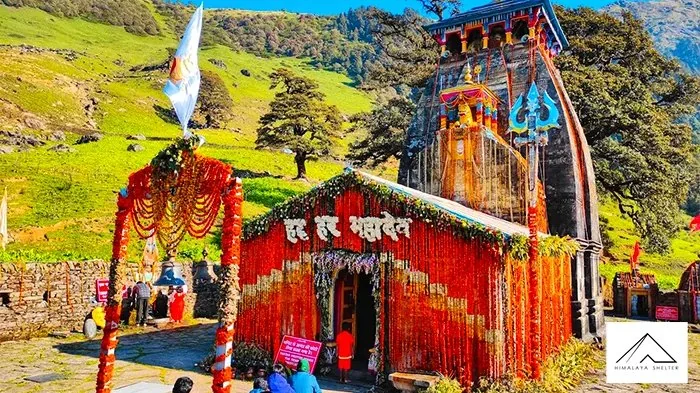
Rudranath stands at about 3,600 m (about 11,800 ft) in Chamoli district. Here the face (mukha) of Shiva is worshipped as Neelkanth Mahadev, in a temple built into natural rock. Holy pools such as Surya Kund are close to the temple. In winter, the deity is worshipped at the Gopinath Temple in Gopeshwar (general knowledge).
Rudranath is the most remote of the five. The usual route starts at Sagar village, about 5 km from Gopeshwar, and climbs through rhododendron forest to the meadows of Lyuti Bugyal and Panar Bugyal, then past Pitradhar to the temple. There is little or no mobile network above Sagar, and registration is needed at Sagar village or Gopeshwar before you start. Our Rudranath trek takes 5 days from Dehradun.
Rudranath temple decorated with marigolds.
5. Kalpeshwar: the hair
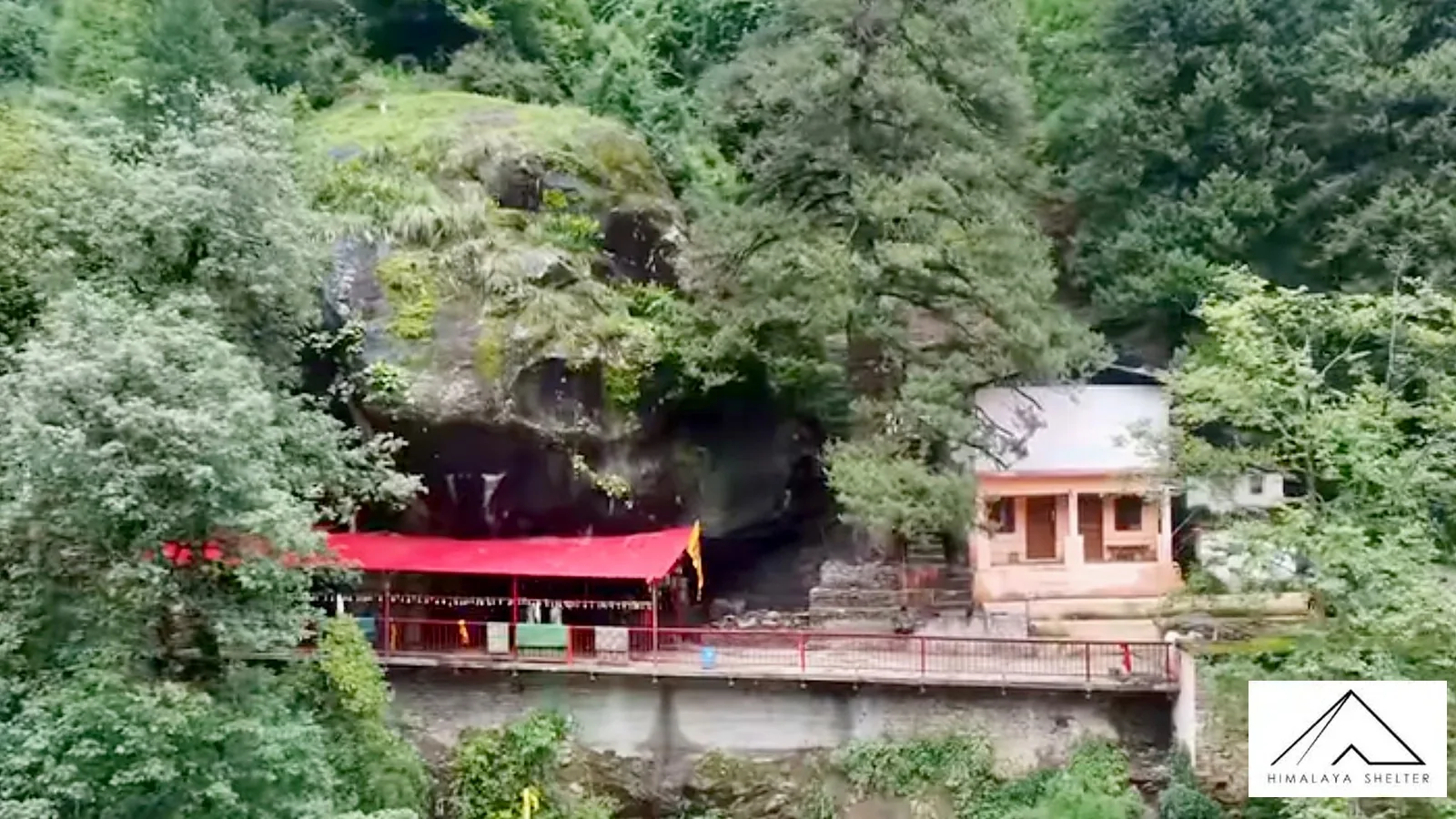
Kalpeshwar is the lowest of the five at 2,200 m (7,217 ft). It stands in the Urgam Valley of Chamoli district, near the Kalpganga river, and the matted hair (jata) of Shiva is worshipped here, which is why it is also called Jateshwar Mahadev. The shrine is inside a small natural cave, and the temple of Dhyan Badri is close by.
Kalpeshwar is the only Panch Kedar temple that stays open all year. It is also the easiest to reach: from Helang on the Rishikesh to Badrinath highway, a local road goes up to Urgam and Devgram, and from there it is a short walk to the temple. By road, it is about 286 km from Dehradun. Our Kalpeshwar temple trek takes 3 days from Dehradun and is graded easy.
The five temples lie between two river valleys in Garhwal: the Mandakini valley on the west side and the Alaknanda valley on the east side. Each temple has its own road head, the last point a vehicle can reach, and from there you walk. The table lists them in the traditional order.
Temple
District
Nearest road head
Kedarnath
Rudraprayag
Gaurikund
Madhyamaheshwar
Rudraprayag
Ransi
Tungnath
Rudraprayag
Chopta
Rudranath
Chamoli
Sagar village
Kalpeshwar
Chamoli
Urgam
The Panch Kedar route in simple words
From Dehradun or Rishikesh, the road follows the Ganga upstream through Devprayag to Rudraprayag, where the Mandakini meets the Alaknanda. This is where the route splits.
Mandakini side (Kedarnath and Madhyamaheshwar): follow the Mandakini past Guptkashi and Sonprayag to Gaurikund for Kedarnath. Across the valley, Ukhimath is the turn-off for the road to Ransi, the start of the Madhyamaheshwar trek.
Middle ridge (Tungnath): from Ukhimath, a mountain road climbs to Chopta, the start of the Tungnath walk, and continues down to Mandal and Gopeshwar.
Alaknanda side (Rudranath and Kalpeshwar): Gopeshwar is the base for Sagar village and the Rudranath trek. Further up the Badrinath highway, Helang is the turn-off for Urgam and Kalpeshwar.
To see the route on your phone, search the road heads in Google Maps in this order: Gaurikund, Ransi, Chopta, Sagar (Gopeshwar), Urgam. On foot, there is also an old trail from Urgam over the ridge to Rudranath, via Dumak and Panar Bugyal, and from Rudranath down via Naola Pass to Mandal. Our Panch Kedar trek uses this trail, so you walk between the Alaknanda-side temples instead of driving.
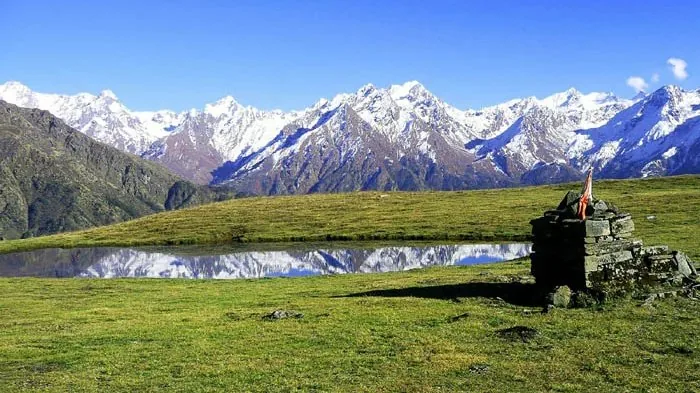
The meadow above Madhyamaheshwar, with the snow peaks of the Chaukhamba range behind.
Panch Kedar Yatra: How to Plan Your Visit
There are two ways to do the Panch Kedar yatra. You can visit the temples one by one, driving between road heads and walking up to each temple and back. Or you can do it as a single long trek, which joins some of the temples on foot. The first suits people who want to see one or two temples in a short holiday. The second suits trekkers who want the whole circuit in one go.
If you go temple by temple, plan the trips around the season and your fitness. These are the separate treks we run to each temple, all starting and ending in Dehradun:
Our trek
Days from Dehradun
Kalpeshwar Temple Trek
3 days, easy
Chopta Chandrashila Tungnath Trek
3 days, easy
Buda Madmaheshwar Trek
4 days, moderate
Rudranath Trek
5 days
Panch Kedar Trek (all five)
13 days, moderate to difficult
Kedarnath is usually visited as part of the Char Dham or Do Dham yatra, or on the full Panch Kedar trek. If you add it to a separate trip, keep in mind that the road and trail are at their busiest in May, June and early October.
Panch Kedar Trek and Trekking
The Panch Kedar trek is the complete circuit on foot and by road. Our version is 13 days from Dehradun, about 160 km in total, graded moderate to difficult, with groups of up to 12. Pickup is at Prince Chowk in Dehradun. The fee is ₹65,000 per person plus 5% GST.
In short, the route goes Dehradun to Karnaprayag, then Urgam and Kalpeshwar, over Dumak and Panar Bugyal to Rudranath, down via Naola Pass and Anusuya Devi to Mandal, on to Chopta for Tungnath and Chandrashila, across to Deoriatal and Sari, up from Ransi to Madhyamaheshwar, and finally from Gaurikund to Kedarnath before the drive back to Dehradun. The highest point on the trek is Chandrashila summit, above Tungnath.
The fee covers stays in homestays and guest houses at the bases and 2-person tents on the trail, sleeping bags and foam mattresses, vegetarian meals with eggs, an AMC-certified trek leader with local guides, a medical kit with oxygen, and forest entry charges for Indian nationals. Trek insurance is charged on top. The full day-by-day itinerary, inclusions and upcoming dates are on the Panch Kedar trek page.
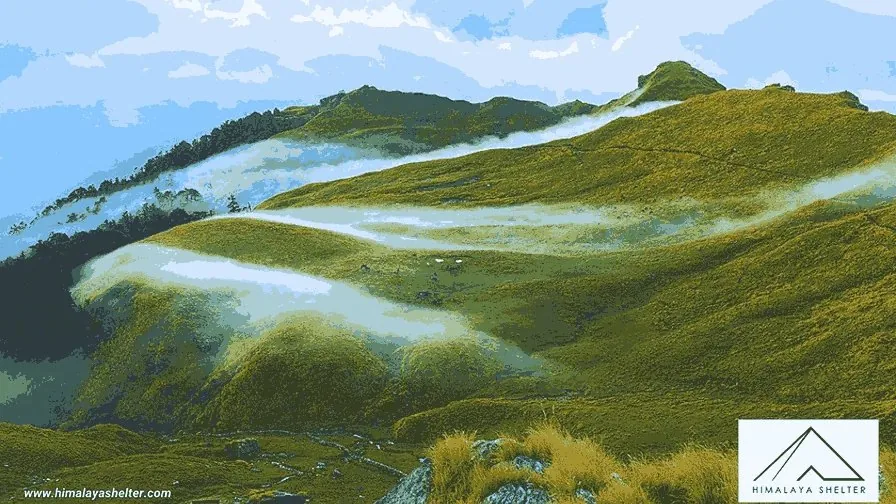
Meadows and low cloud on the way to Rudranath.
Panch Kedar Opening and Closing Dates 2026
Four of the five temples close for winter, and their deities move to lower winter seats. The exact opening and closing dates are fixed every year by the temple committee on auspicious days of the Hindu calendar. Kedarnath's opening date, for example, is announced on Mahashivratri. So there is no fixed date to remember, only the usual pattern.
Temple
Usually open
Kedarnath
Apr/May to around Diwali
Madhyamaheshwar
May to Oct/Nov
Tungnath
Apr/May to around Diwali
Rudranath
May to Oct/Nov
Kalpeshwar
All year
In winter, the deities of the four closed temples are worshipped at their winter seats:
As of 20 October 2026, the 2026 season is ending: the temples close one by one between October and November, and some may already be closed. The 2027 opening dates will be announced in 2027, before the season starts. Always confirm the current year's dates from official announcements before you book travel.
Best Time for the Panch Kedar Yatra
The best months are May and June, and September and October. In these months all five temples are open, the trails are mostly free of snow, and the days are pleasant for walking.
May and June: the season opens, rhododendrons and meadows are in bloom, and it is the busiest time at Kedarnath.
July and August: the monsoon brings heavy rain and a risk of landslides on the mountain roads. The meadows are green, but plan extra days.
September and October: after the rain, the air is clear and the mountain views are at their best. Nights get cold by October.
November to April: four temples are closed. Kalpeshwar stays open, but snow can make the roads and paths difficult. The Chopta to Tungnath trail is a popular snow walk in winter even though the temple is closed.
Which Panch Kedar Is the Toughest?
Rudranath is the toughest of the five. The route is the longest and most remote, with steep climbs, rocky stretches and long sections where the trail is easy to lose without a guide. Kalpeshwar is the easiest. Here is how they compare, from easiest to toughest.
Temple
Walk and effort
Kalpeshwar
Short walk from Urgam or Devgram. Easiest.
Tungnath
3.5 km from Chopta. Easy, steady climb.
Kedarnath
16 km from Gaurikund. Long, but on a made path.
Madhyamaheshwar
16 km from Ransi. Moderate, a long day.
Rudranath
Multi-day trail from Sagar. Toughest.
Altitude adds to the effort. Four temples are above 3,400 m, so altitude sickness is possible even though none is above 4,000 m. Climb slowly, drink plenty of water and rest well at night, and tell your trek leader early if you get a headache or feel sick.
Tips for the Panch Kedar Yatra
Register in advance: registration is needed for Kedarnath, and for Rudranath at Sagar village or Gopeshwar.
Carry cash: ATMs are found in towns such as Gopeshwar, Ukhimath and Nandaprayag, but there are few of them, and there are none on the trails.
Expect weak network: mobile signal is limited on most trails and almost absent on the Rudranath route.
Train before you go: walk daily, climb stairs with a backpack and do a few short hikes. The full circuit means walking on most days for about two weeks.
Pack in layers: thermals, a fleece, a warm jacket and a rain jacket, plus trekking shoes you have already worn in.
Keep buffer days: rain or landslides can close a road for a day, especially in the monsoon.
Book Your Panch Kedar Trek
If you want to visit all five Kedars in one trip, with the walking, stays, meals and permits planned for you, see the dates and full itinerary on the Panch Kedar trek page and send an enquiry. For a shorter trip, choose one of the single-temple treks above.
Not sure which option suits you? Call or WhatsApp +91 94583 86006 and our team will help you plan your Panch Kedar yatra.
Frequently Asked Questions
Which are the 5 Kedars?
The five Kedars, or Panch Kedar, are Kedarnath, Madhyamaheshwar, Tungnath, Rudranath and Kalpeshwar. They are temples of Lord Shiva in the Rudraprayag and Chamoli districts of Uttarakhand. In Hindi: केदारनाथ, मध्यमहेश्वर, तुंगनाथ, रुद्रनाथ और कल्पेश्वर.
In which order should I visit Panch Kedar?
The traditional order is Kedarnath, Madhyamaheshwar, Tungnath, Rudranath and Kalpeshwar. You can also go the other way round. Our 13-day Panch Kedar trek starts with Kalpeshwar and Rudranath and ends at Kedarnath, which follows the road and trail links well.
Which Panch Kedar is open all year?
Kalpeshwar, in the Urgam Valley of Chamoli district, is the only Panch Kedar temple that stays open all year. The other four close for winter, usually around Diwali or in November, and reopen in April or May.
Which is the toughest Panch Kedar?
Rudranath is the toughest. Its trail from Sagar village is the longest and most remote of the five, with steep climbs, rocky stretches and little mobile network. Kalpeshwar is the easiest, with only a short walk from the road.
Which Panch Kedar temple is the highest?
Tungnath, at 3,680 m (12,073 ft), is the highest Panch Kedar temple and the highest Shiva temple in the world. Kedarnath is at 3,583 m, Rudranath at about 3,600 m, Madhyamaheshwar at 3,497 m and Kalpeshwar at 2,200 m.
What is the cost of the Panch Kedar trek with Himalaya Shelter?
Our 13-day Panch Kedar trek from Dehradun is ₹65,000 per person plus 5% GST, with trek insurance charged on top. Our shorter single-temple treks start from ₹9,900 for the Chopta Chandrashila Tungnath trek and go up to ₹26,000 for the Rudranath trek. Check the trek pages for the latest fees and dates.
How many days does the Panch Kedar trek take, and how difficult is it?
Our Panch Kedar trek takes 13 days from Dehradun and covers about 160 km. It is graded moderate to difficult because of the long walking days, especially on the Rudranath section. Beginners with good fitness can do it if they train for a few weeks before the trek.
What is the best time for the Panch Kedar yatra?
The best months are May and June, and September and October, when all five temples are open and the weather is good for walking. July and August bring monsoon rain and landslide risk. From November to April, only Kalpeshwar is open.